

Q-System#
Barton et al. (1974) [1] studied a large number of underground excavation case histories and developed the Tunnelling Quality Index, Q. It is a means of classifying rockmasses with respect to in situ parameters including rock quality, joint condition and stress state. Q is defined by:
Barton et al. (1974) [1] proposed the following classifications of rockmass quality based on the evaluation of Q:
Tunnelling Quality Index, Q |
Rock Mass Description |
|---|---|
0.001 - 0.01 |
Exceptionally Poor |
0.01 - 0.1 |
Extremely Poor |
0.1 - 1 |
Very Poor |
1 - 4 |
Poor |
4 - 10 |
Good |
10 - 40 |
Very Good |
40 - 100 |
Very Good |
100 - 400 |
Extremely Good |
400 - 1000 |
Exceptionally Good |
In hard rock mines, Q typically ranges from 0.1 to 100.
Parameters#
The factors which make up Q are determined as shown in the following sections.
Jn: Joint Sets Number#
Jn rates the number of identified joint sets.
This factor accounts for the number of repetitive joint sets and the relative dominance of random fracturing and jointing. Jn ranges from a value of 0.5 (no joints) to 20 (completely crushed rock).
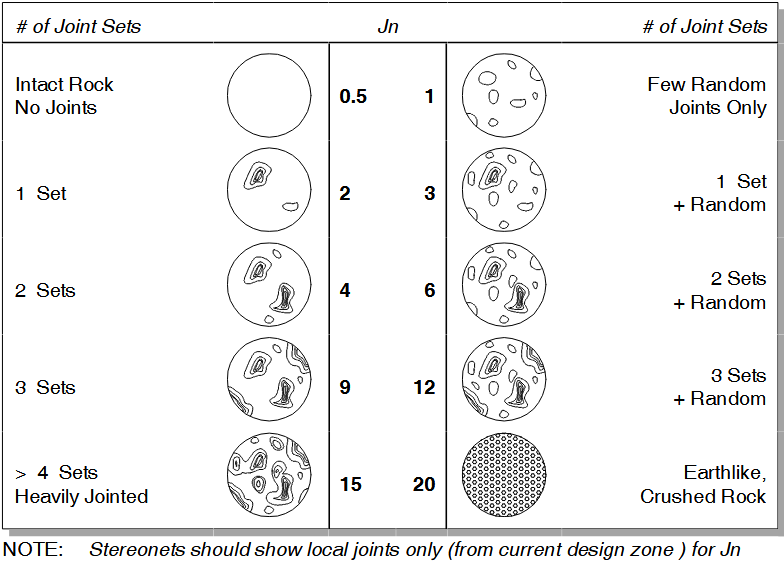
Figure 1: Joint sets number#
Jr: Joint Roughness Number#
Jr describes the large and small scale surface texture of the critical joint set. Jr ranges from 0.5 (unfavourable) to 4.0 (favourable).
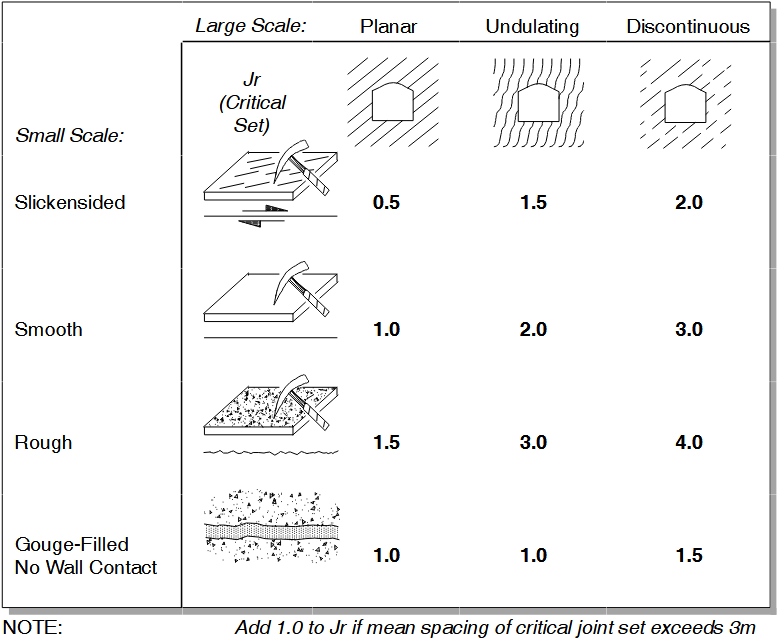
Figure 2: Joint roughness number (from Hutchinson & Diederichs 1996) [2]#
Ja: Joint Roughness Number#
Ja describes the surface alteration and frictional resistance of the critical joint set and ranges from 0.75 (favourable) to 20 (unfavourable).
Description (Critical Joint) |
Ja |
|---|---|
Tightly Healed |
0.75 |
Surface Staining Only |
1.0 |
Slightly Altered Joint Walls. Sparse Mineral Coating. |
2.0–3.0 |
Low Friction Coating (Chlorite, Mica, Talc, Clay) < 1 mm thick |
3.0–6.0 |
Thin Gouge, Low Friction or Swelling Clay (1–5 mm thick) |
6.0–10.0 |
Thick Gouge, Low Friction or Swelling Clay (> 5 mm thick) |
10.0–20.0 |
Jw: Joint Water Reduction#
Jw accounts for the weakening effect of groundwater and for the effective normal stress reduction due to water pressure. Consider mine water only if it is persistent. Do not consider water inflow from temporary drilling, for example.