

RQD#
The “Rock Quality Designation” Index, RQD, was introduced by Deere (father) in 1963 [1].
The RQD is a quantitative index based on a core recovery procedure in which the core recovery is determined incorporating only those pieces of hard, sound core that are 100 mm or greater in length. Shorter lengths of core are ignored.
The RQD is calculated as:
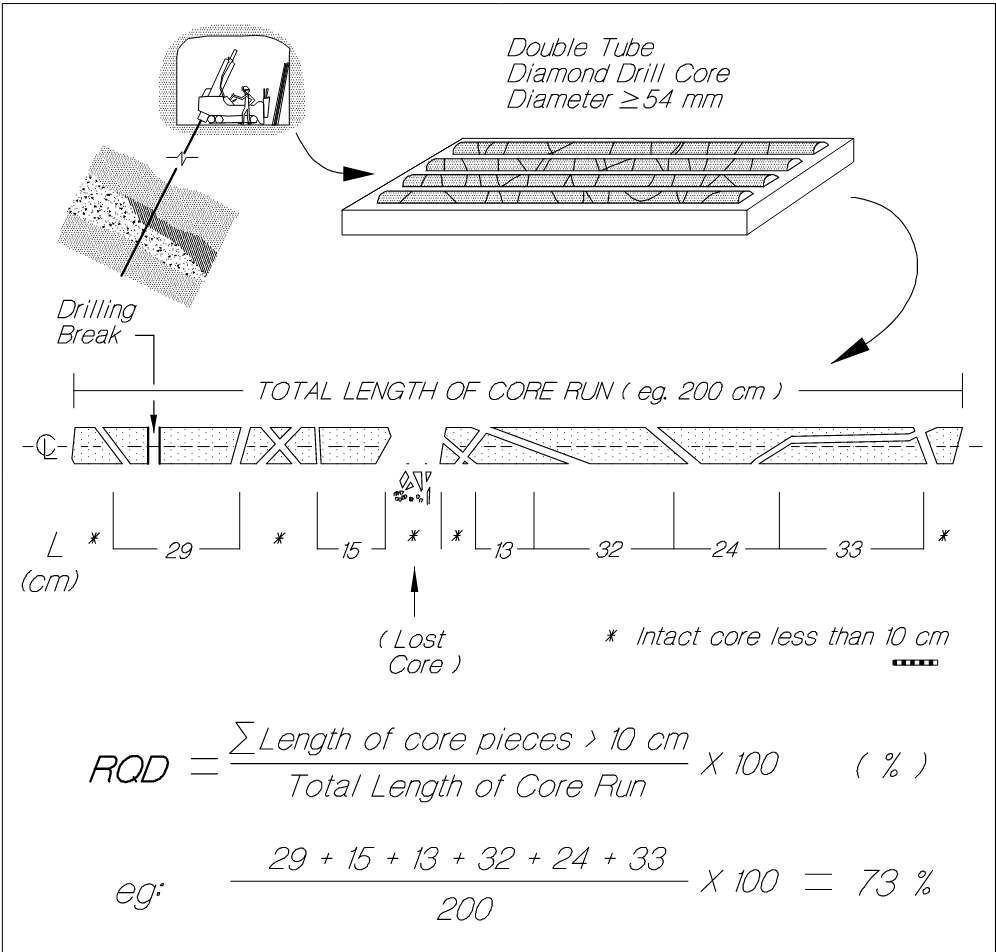
Figure 1: Conventional method for evaluating RQD from drill core#
Rock Quality Designation, RQD |
Rock Mass Description |
|---|---|
0 - 25 |
Very Poor |
25 - 50 |
Poor |
50 - 75 |
Fair |
75 - 90 |
Good |
90 - 100 |
Excellent |
ISRM (1981) [2] and Deere (1963) [1]:
“RQD must be determined over intervals not exceeding 2.0 [m], ideally 1.0 [m]” — longer intervals reduce sensitivity to local fracturing.
⚠️ What happens when RQD is calculated over 3 [m] or more?
Fault zones or fractured bands may be diluted (a 0.3 [m] fractured band in 3.0 [m] looks insignificant).
Misclassification in systems like RMR, Q-system, or GSI.
Support designs based on misleadingly “good” rock may fail.